 Ultimate guide
The Warehouse Manager's Guide to Durable Loading Dock Doors
Last Updated: November 10, 2026
Quick Summary
Choosing durable loading dock doors means matching the door type to real traffic volume: sectional doors suit low-to-moderate use and climate control, rolling steel doors handle high-cycle abuse, and high-performance doors justify their premium where cycles are near-constant. Always ask for a published cycle rating in writing before comparing doors.
- Rolling steel doors coil into a drum, so they need no overhead track or ceiling clearance.
- A 20- or 18-gauge steel slat resists forklift impact better than 24-gauge on busy docks.
- Aluminum resists corrosion well but dents easily under forklift contact, binding in its guides.
- Maintenance frequency should follow cycle count, not the calendar alone.
- Stock common wear parts on site, since their cost is small next to lost throughput.
Table of Contents
- Types of Dock Doors and How They Handle Traffic
- Matching Door Type to Facility Use and Traffic Volume
- Door Materials and Durability: Steel, Aluminum, and Fiberglass
- Loading Dock Door Size: Height, Width, and Custom Dimensions
- Commercial Roll-Up Door Wind Resistance Testing Explained
- Dock Door Maintenance Best Practices and Downtime Planning
- Insulation, Energy Efficiency, and Weather Protection
- Specifying Your Loading Dock Doors for Your Next Project
- Frequently Asked Questions
Types of Dock Doors and How They Handle Traffic
Choosing durable warehouse loading dock doors starts with one question: how hard will the door work? Sectional doors suit moderate use and tight climate control. Rolling steel doors absorb heavy cycles and abuse.
The door that fails first is usually the one undersized for its cycle count. Match the door to the dock.

Sectional Doors
Sectional doors are paneled doors that lift and fold horizontally overhead along tracks. They offer strong insulation and a clean seal when closed, making them common for climate-controlled spaces and service bays. The trade-off is mechanical complexity: hinges, rollers, and track alignment all wear, and a misaligned panel can jam the opening. They perform well for low-to-moderate traffic; for constant forklift traffic, the tracks become a liability.
Rolling Steel and Roll-Up Doors
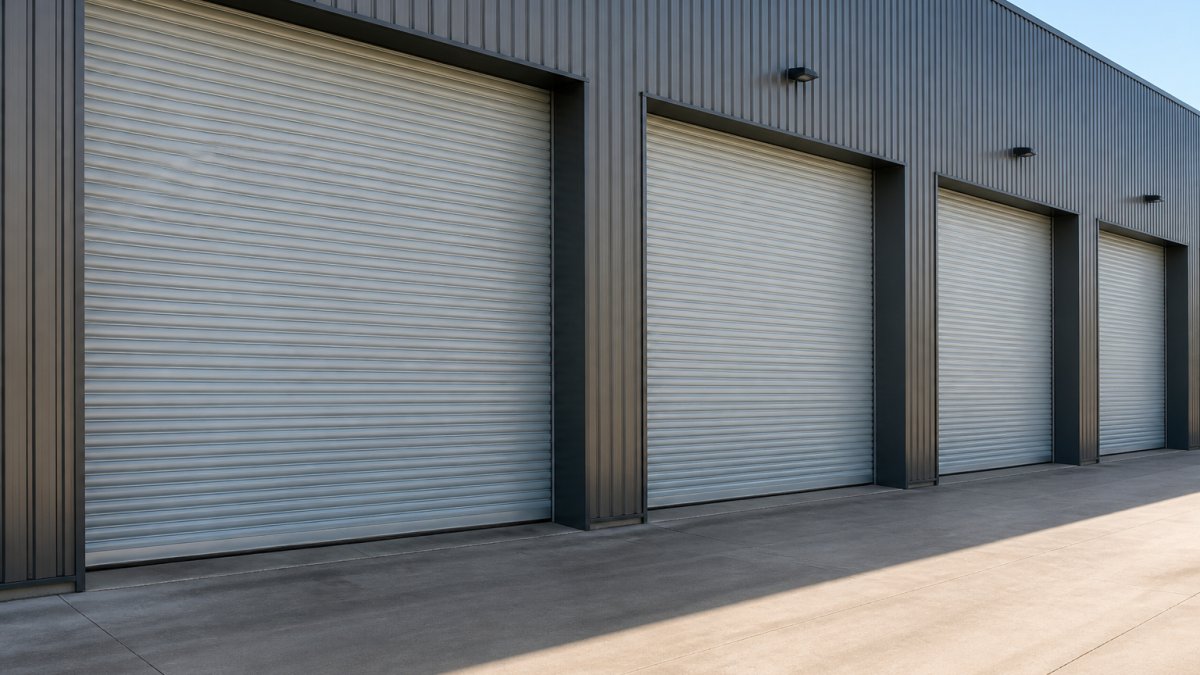
Rolling steel and roll-up doors coil into a compact drum above the opening, so they need no overhead track and no ceiling clearance. That makes them the workhorse of high-cycle docks: fewer moving parts, less to knock out of alignment, and a smaller footprint. To browse available options before deciding, you can view roll-up door models by size and specification.
High-Performance Doors
High-performance doors open fast, often in a fraction of the time a standard door takes, and seal tightly on close. They shine where traffic is frequent and climate loss matters, such as busy distribution docks and cold-storage transitions. The drawbacks are higher upfront cost and more sophisticated controls that need proper setup. For near-constant cycles, the speed and sealing can justify the premium.
Matching Door Type to Facility Use and Traffic Volume
The right door type follows from traffic volume and operating frequency, not a catalog page. A self-storage facility opening a few doors a day has different needs than a distribution center cycling doors hundreds of times per shift.
A practical way to decide:
- Low frequency, climate-sensitive: sectional doors for insulation and sealing
- High frequency, abuse-heavy: rolling steel and roll-up doors for durability and low maintenance
- Very high frequency, tight climate control: high-performance doors for speed and sealing
A common mistake is buying on upfront price alone. The door that costs least today often costs most over its service life once repairs and downtime are counted.
Door Materials and Durability: Steel, Aluminum, and Fiberglass
Material choice drives durability, corrosion resistance, and maintenance, but the real comparison happens at the specification level. Two doors made of the same steel can differ noticeably in cycle rating and service life depending on slat gauge, coating system, and hardware quality.
Steel: The Default for Heavy-Duty Docks
Steel is the workhorse material for loading dock doors because it balances strength, impact resistance, and cost. The key variables are slat thickness (gauge), coating, and hardware.
When comparing steel doors, ask for the cycle rating, the number of open-close cycles the door is tested to complete before major component failure. Cycle ratings vary widely between light-duty and heavy-duty models.
Aluminum: Light and Corrosion-Resistant, But Dent-Prone
Aluminum doors resist corrosion naturally, which fits humid, coastal, or wash-down environments where steel would need expensive coating systems. The trade-off is impact resistance: aluminum dents more easily under forklift contact, and a dented slat can bind the door in its guides. For careful traffic and a corrosion problem, aluminum is a strong choice; for abuse-heavy docks, it is usually the wrong tool.
Fiberglass: Corrosion Resistance and Insulation, With Impact Limits
Fiberglass doors resist corrosion and offer good thermal insulation because the material itself is a poor conductor. They suit corrosive environments and climate-controlled spaces where steel would need insulation added. The limitation is impact: fiberglass can crack under hard contact, and cracks are difficult to repair invisibly. In a dock with frequent forklift traffic, reserve fiberglass for openings where impact risk is low.
Measurable Specifications to Compare
Material alone does not determine durability. Use these specifications to compare doors objectively:
- Cycle rating: the tested number of open-close cycles before major failure. Match this to your annual cycle count times expected service life.
- Impact resistance: look for tested resistance to a specified impact load, or ask how the door performs after a forklift strike.
- Wind-load rating: a certified rating from a recognized testing standard, not a generic claim. This matters for both storm exposure and door structural integrity.
| Material | Typical Cycle Rating Range | Impact Resistance | Corrosion Resistance | Best For |
|---|---|---|---|---|
| Steel (heavy-duty) | 25,000-100,000+ cycles | High | Needs coating; galvanized or coated options | High-traffic, heavy-duty docks |
| Steel (light-duty) | 10,000-25,000 cycles | Moderate | Needs coating | Low-to-moderate traffic, budget projects |
| Aluminum | 10,000-50,000 cycles | Moderate; dents easily | Strong | Humid or coastal facilities with careful traffic |
| Fiberglass | 10,000-50,000 cycles | Good but can crack | Strong | Corrosive environments, insulation needs |
Ask for a published cycle rating in writing before you compare doors.
For a deeper comparison of material choices for busy docks, our guide to the best materials for high traffic doors covers the trade-offs in detail.
Loading Dock Door Size: Height, Width, and Custom Dimensions
Loading dock door size comes down to the largest vehicle and load the opening must clear, plus a margin for safe operation. Measure the tallest truck and the widest load, then size the opening so equipment passes without contact.
Opening height and width should account for truck bed heights, dock levelers, and the swing or travel of the door itself. If your project needs non-standard dimensions, our buying guide on custom size roll up doors walks through how to specify them.
Commercial Roll-Up Door Wind Resistance Testing Explained
Commercial roll-up door wind resistance testing measures how a door performs under simulated wind pressure, so buyers can match a door to the wind exposure at their site.
Wind exposure varies by location, building height, and how sheltered the opening is. Our companion article on what wind load rating roll-up doors need explains how to read those ratings.
Dock Door Maintenance Best Practices and Downtime Planning
Dock door maintenance best practices are simple and prevent most failures: inspect hardware and fasteners regularly, keep tracks and rollers clean, lubricate moving parts on a schedule, and check seals for wear. But maintenance is only half the equation. The other half is planning for the failure that happens anyway, and that planning starts before you buy the door.
A Maintenance Schedule That Matches Your Traffic
Maintenance frequency should follow cycle count, not the calendar alone. A door cycling 100 times a day needs more frequent inspection than one cycling 10 times a day. A practical baseline:
- Daily: visual check for obvious damage, obstructions, and unusual noise during operation.
- Monthly: inspect hardware and fasteners for looseness, check tracks and rollers for debris, and test safety devices.
- Quarterly: lubricate moving parts per the manufacturer's schedule, check seals and weather stripping for wear, and inspect cables and springs for signs of fatigue.
Watch out: lubricating the wrong components, such as tracks on some door types, can attract dust and accelerate wear. Follow the manufacturer's lubrication points, not a generic checklist.
Repairability: The Specification Buyers Forget
Repairability separates a minor fix from a multi-day closure. Before you buy, ask three questions:
- Are components modular? A door built from interchangeable slats, guides, and hardware can be repaired section by section. A door with proprietary or welded components may require replacing a larger assembly.
- Are wear parts stocked domestically? Rollers, hinges, cables, springs, and seals are the parts that fail first. Confirm the supplier stocks them and can ship quickly.
- What is the lead time for a replacement door or major assembly? If a door is damaged beyond repair, how long until a replacement arrives? For a multi-door facility, that lead time can determine whether you lose a dock for a shift or a week.
A common pattern is to buy on upfront price and discover later that parts are special-order with long lead times. The cheapest door can become the most expensive one when a $50 part takes two weeks to arrive and the dock sits idle.
Downtime Planning: Protect Throughput Before the Failure
A failed dock door can shut down a dock position entirely, forcing rerouting, overtime, or missed shipping windows. Plan for it:
- Stock common wear parts on site: rollers, hinges, cables, seals, and fasteners for each door model. The cost is small compared to a day of lost throughput.
- Identify which doors are critical: not every door matters equally. A door serving a main shipping lane deserves priority spares and a faster service arrangement than a low-use door.
- Confirm service response times: ask your supplier or service provider what response time they commit to, and whether they offer emergency service.
A Simple Decision Framework for Repairability
When comparing doors, score each on these criteria:
| Criterion | What to Ask | Why It Matters |
|---|---|---|
| Modular components | Are slats, guides, and hardware interchangeable? | Faster, cheaper repairs |
| Parts availability | Are wear parts stocked and shippable quickly? | Reduces downtime |
| Lead time | How long for a replacement door or major assembly? | Determines dock closure risk |
| Service network | Is there a committed response time? | Speeds recovery |
| Documentation | Are specs and parts lists provided? | Enables self-service ordering |
- Inspect hardware and fasteners monthly
- Clean and lubricate tracks and rollers on schedule
- Check seals and weather stripping for wear
Downtime planning matters as much as maintenance. Keep common wear parts on hand, know your supplier's lead times, and have a plan for a door that fails during a busy shift. A common mistake is waiting for a failure to source parts; by then the dock is already backed up.
Insulation, Energy Efficiency, and Weather Protection
Insulation and weather protection decide how much energy a dock door costs you over time. A poorly sealed door leaks air, forcing HVAC systems to work harder and letting weather into the facility.
Dock seals and shelters close the gap between the door and the truck, cutting drafts and keeping out rain, dust, and pests. For cold-storage and climate-sensitive operations, an insulated door plus a well-fitted seal keeps energy efficiency on track.
Specifying Your Loading Dock Doors for Your Next Project
Specifying loading dock doors means turning your facility requirements into a clear order: door type, material, dimensions, wind rating, insulation, and controls.
Start with a simple checklist before you buy:
- Traffic and cycles: match door type to operating frequency
- Dimensions: measure the largest vehicle and load, then confirm custom sizes
- Material: choose for corrosion exposure and impact
Pre-assembled designs are built to simplify installation on site, which matters on multi-door projects. When you are ready to specify and buy, our guide on getting a quote for warehouse doors explains the process.
Getting durable loading dock doors right is mostly about matching the door to the real workload and specifying it precisely.
Frequently Asked Questions
What are the OSHA requirements for dock doors?
OSHA's general industry standards under 29 CFR 1910 address dock openings as part of walking-working surfaces and guarding. The key requirement is that open dock edges and door openings are guarded or otherwise protected so employees are not exposed to falls or struck-by hazards. Specific door hardware and configuration are not prescribed; instead, employers must assess the hazard and provide guarding, signage, and safe procedures. Confirm current requirements with OSHA or a qualified safety professional for your facility.
What is the ideal width for a loading dock door?
There is no single ideal width. Standard dock openings commonly run 8 to 9 feet wide and 8 to 10 feet high, but the right loading dock door size depends on your largest trailer, forklift clearance, and whether loads are palletized or hand-stacked. Measure the widest vehicle and the tallest load, then add clearance for mirrors, dock levelers, and seals. If your fleet is mixed, size for the largest trailer you expect to serve regularly rather than the average.
Which materials make a loading dock door more durable?
Steel offers the highest impact and corrosion resistance for heavy-duty applications and is the common choice for rolling and sectional doors in industrial settings. Aluminum resists rust well and suits coastal or humid sites but dents more easily. Fiberglass resists chemicals and provides good insulation but can crack under impact. Durability also depends on panel gauge, hardware quality, and cycle rating, so material choice should be paired with a specification that matches your traffic volume.
How do I choose the right size for a warehouse dock door?
Start with your trailer fleet: record the widest and tallest vehicles you serve and add clearance for dock seals, levelers, and forklift masts. Then confirm the opening height, opening width, and headroom above the door for the track or roll. If your operation handles varied trailer sizes, choose custom dimensions rather than forcing a standard size. Document the dimensions and share them with your supplier so the door, hardware, and seal are specified together.
What should I consider when selecting a roll-up door for a loading dock?
Focus on cycle rating, wind load rating, material, and repairability. A door that opens 40 times a day needs a different specification than one that opens four times. Check that the wind resistance testing matches your local wind exposure, confirm parts availability for springs, rollers, and panels, and plan for downtime with spare hardware. Insulation and sealing matter if the dock separates conditioned space from the outdoors. Match all of these to your traffic and climate before comparing price.